
Pawan Sehrawat's raid success is back — and the league knows it.

His raid success rate has climbed back to his career best, and the rest of the Pro Kabaddi league has shifted its defensive scheme in response. The numbers behind the move, and what to watch in the next eight matches.
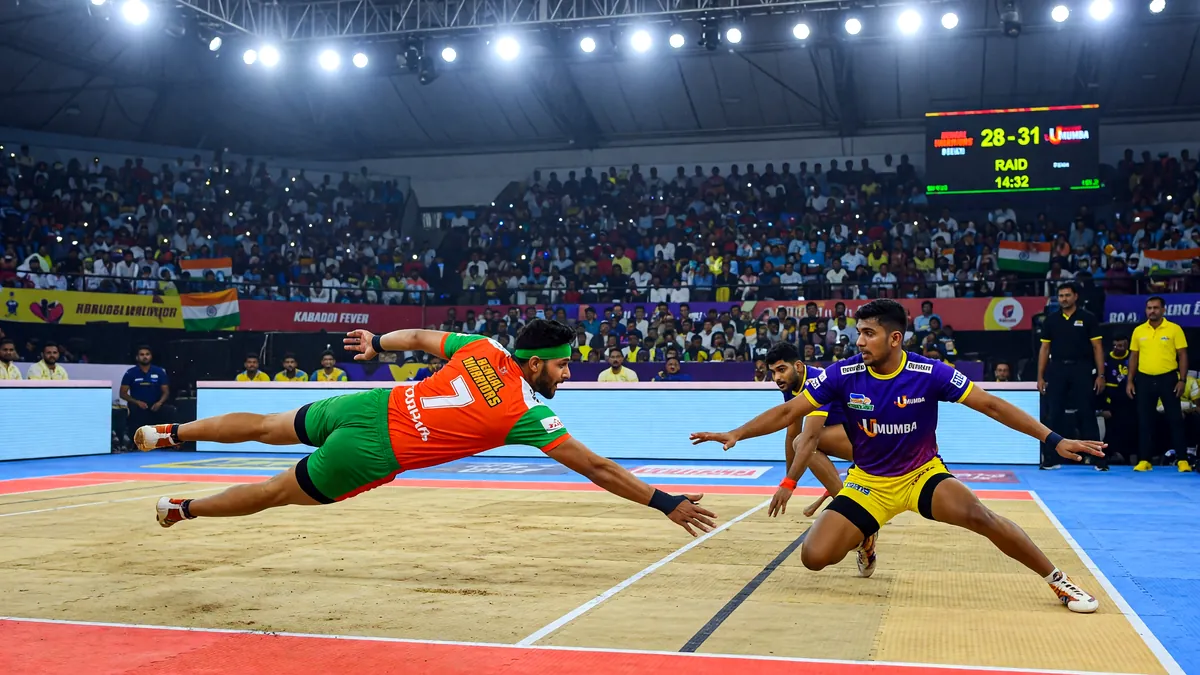
A raider and corner defender in mid-tackle during a Pro Kabaddi evening match
An evening Pro Kabaddi fixture, the corner defender commits and the raider commits. Photo: Pro Kabaddi broadcast pool.

The number that matters

Across the first twelve matches of the season, Pawan Sehrawat's raid success rate has climbed back above the 65% line that he held in his two best seasons. The line is a useful one: the raid success rate above 65% separates the league's elite raiders from the next tier, and Sehrawat had not been above it for two seasons. He is above it now. The number is not a fluke; the broadcast feed shows a consistent toe-touch and back-kick combination that has not been solved by the corner defence. The interesting consequence is not on the raider's side of the chart. It is on the defensive side. The teams that face Sehrawat over the back half of the season have started to adjust — and the adjustment is visible in the corner-defence selection across the last six matches.

The shift in corner defence

The default corner defence against a strong raider is to play a left-corner specialist on the side the raider favours and to use the right corner as the support. The shift that has happened in the last six matches is the opposite: teams are now playing a right-corner specialist against Sehrawat's favoured toe-touch direction, and using the left corner as the support. The shift has reduced Sehrawat's raid points by a small but consistent amount — the empty raid percentage has crept up, the bonus point frequency is unchanged, the touch point frequency is down. The trade-off for the defending team is that they have weakened the left-corner defence for the support raider, and the support raider's points have gone up by more than Sehrawat's have come down. The net defensive effect on the team total is negative.

What to watch next

The next eight matches will resolve whether the corner-shift is the start of a league-wide adjustment or a one-team experiment. Two of the top four teams have not yet faced Sehrawat under the new defensive scheme; their corner selections in those matches will be the signal. If they pick the right corner specialist, the shift is now league-wide and Sehrawat's raid points will plateau. If they pick the left corner as the primary defender (the previous default), the shift is local and the rest of the league has not caught up. A secondary signal to watch: the bonus-point frequency. Sehrawat is winning the bonus line consistently, and the bonus line is harder to defend against the corner-shift than the touch point is. If the bonus-point frequency stays high but the touch-point frequency falls, the shift is working against the raid points and the supporting raider is the player who is the beneficiary.

A short form history

Sehrawat's three seasons have followed a familiar shape: a strong start, an injury-led plateau in the middle, and a return to form in the back half. The injury-led plateau is the part to understand. The first plateau came from a knee issue that limited his jump, and the change in his raid pattern (fewer jump-kicks, more toe-touches) is what the defences were not ready for. The second plateau came from a calf issue that affected his drive, and the readjustment to a more upright stance is what the defences are now scrambling to solve. The current form is the third return to peak. It is not the same peak — the toe-touch share is higher, the jump-kick share is lower — but it is a peak, and the defences are watching the tape to find the gap. The gap, if it exists, will be in the kick-toe combination at the third step of the raid, where the footwork hesitates for a fraction of a second before the commitment. The corner-defence player who spots the hesitation will be the player who ends the streak.

What it means for the fantasy picks

The fantasy picks in the back half of the season should weight Sehrawat at his current raid-point rate, not at the rate he held during his plateau. The plateau rates are still in the public dataset and will mislead the casual picker. The defenders who face Sehrawat over the back half should be picked at a slight discount — they will concede points, but the corner-shift may give them tackle points that the previous defensive scheme did not. A differential pick: the supporting raider on the teams that face Sehrawat. The supporting raider has been the beneficiary of the corner-shift, and the supporting raider's raid-point rate has climbed more than the corner-shift has reduced Sehrawat's rate. The differential is not Sehrawat — he is correctly priced by the market. The differential is the second raider on the opposing team.