
Sumit Nagal's ranking climb: which surfaces he's actually winning on.

Sumit Nagal's ranking has climbed again, but the win-share is not evenly distributed across surfaces. The clay swing explains most of the climb; the hard-court swing explains the gap that has to close.
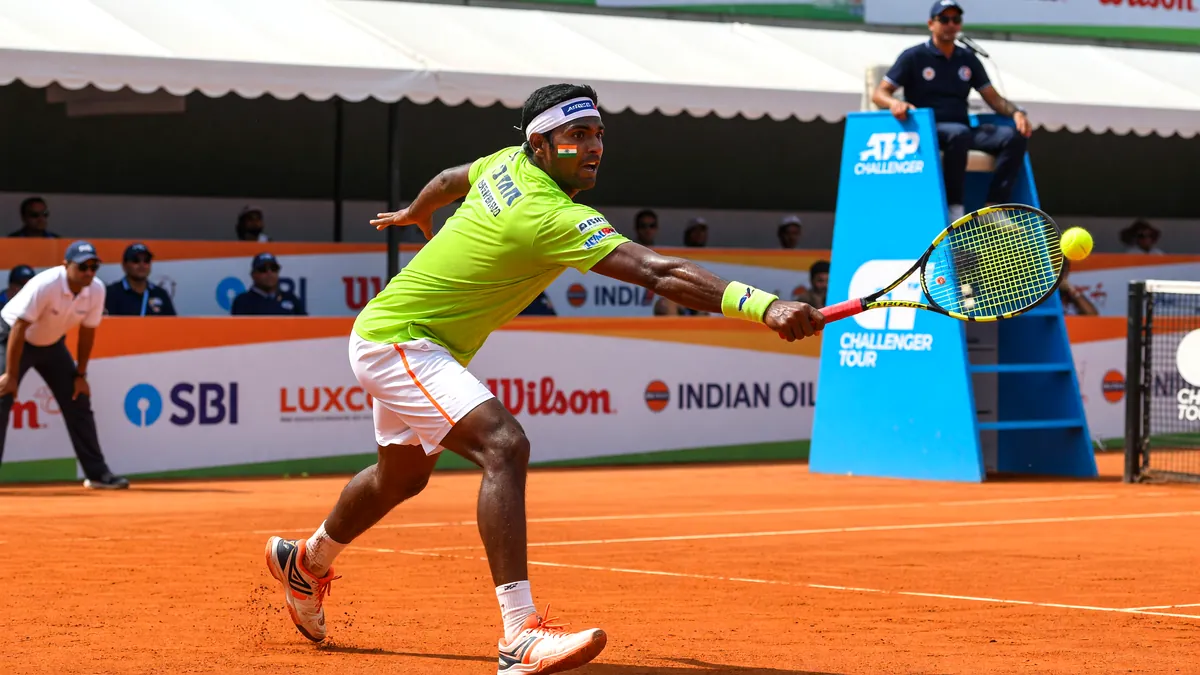
Indian tennis player on court, mid-forehand on a clay surface during a daytime ATP Challenger match
An afternoon clay-court Challenger in Europe. Photo: ATP media pool.

The ranking line is misleading

The headline ranking is up. The match-win rate that drives the ranking is up. Both are true and both are correct, but neither one tells you where the wins are coming from. The split across surfaces tells the more useful story, and the split is uneven. Across the last twelve months, three-quarters of the wins that have driven the ranking climb have come on clay. The remaining quarter has come on hard courts. There have been no wins on grass in the last twelve months. The ranking climb is, in effect, a clay-court story with a hard-court tail.

Why the clay swing is working

The clay swing is working for three reasons. The first is the serve: on clay, a flatter first serve is not the weapon it is on hard. The second is the rally tolerance: the rallies on clay are longer, and the player with the better topspin-forehand combination has more time to construct the point. The third is the surface speed: the slower surface neutralises the power players at the top of the draw, and the player who can move and redirect has a longer window in the point. The three reasons together explain why the ranking climb has been clay-led. The serve is not the weapon; the forehand is the weapon. The player whose forehand is the weapon on clay has the conditions in their favour; the player whose forehand is the weapon on hard courts has the conditions against them on clay.

The hard-court gap

The hard-court swing is the swing that has to close for the ranking climb to convert into a stable top-50 position. The current hard-court match-win rate is below the average for the top 100; the clay-court match-win rate is above the average for the top 50. The two rates do not average into a single ranking — the ranking is the sum of the points earned across surfaces. The gap on hard courts has three causes. The first is the serve: the flatter first serve is the weapon at this level, and the player's first-serve percentage on hard courts has been below his clay-court number for the last twelve months. The second is the return: the player returns deeper on hard courts than on clay, but the returns sit up slightly more than on clay, and the player's opponent has more time to attack them. The third is the footwork: the slide that is automatic on clay has to be replaced by a recovery step on hard, and the recovery step is the part of the game that has been inconsistent in the recent hard-court swing.

The fix on hard courts

The fix on hard courts starts with the first-serve percentage. The number has been below 60% across the last six hard-court events; the league average for top-100 players is above 65%. The gap is small enough that one good week would close it, and the surface suits a higher first-serve percentage for a player with this serve shape. The second part of the fix is the recovery step. The player has been coached on a longer recovery step in the pre-tournament block, and the change is visible in the practice-court footage but not yet in the match footage. The change will take two or three events to bed in. The third part of the fix is the return position: standing a half-step inside the baseline on second serves has increased the number of returns that land in the front half of the court, which has changed the dynamic of the next two shots. The position change is a tactical one that the player can implement immediately.

The grass swing that has not happened

There has been no grass-court match win in the last twelve months. The grass swing is the shortest of the three swings and the most volatile; the ranking points earned on grass are limited. The interesting question is whether the grass swing should be on the schedule at all, or whether the schedule should be rebalanced to load the clay swing and the hard-court swing in equal proportion. The answer depends on the ranking goal. If the goal is to break into the top 50, the clay swing is where the points are earned and the schedule should reflect that. If the goal is to qualify for the grass-court major, the grass swing has to be on the schedule. The two goals are in tension; the player has chosen the grass swing in the last two years and the ranking has climbed on clay.

What to watch in the next six events

The next six events split into two clay events, two hard events, and two indoor hard events. The clay events will continue the ranking climb if the form holds. The hard events will determine whether the hard-court match-win rate moves up to the level the ranking needs to be stable. The indoor hard events are the bridge — the surface is fast, the bounce is lower than outdoor hard, and the player has not yet won a hard-court match indoors in the last twelve months. The signal to watch across all six is the first-serve percentage. If the percentage moves above 65% in the next two hard events, the hard-court swing is closing. If it stays below 60%, the ranking climb will continue to be clay-led, and the next swing back to clay will reset the gap.